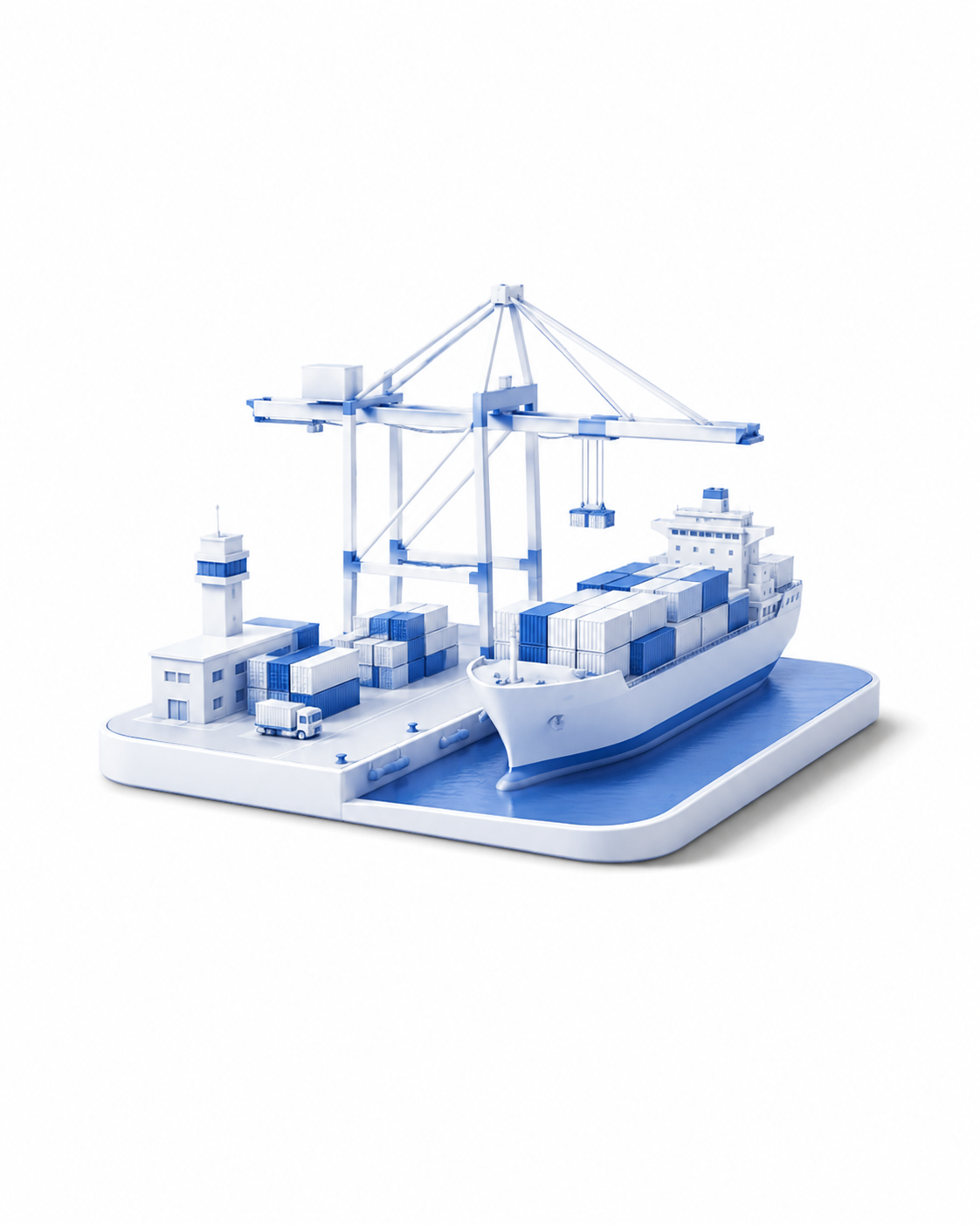


Turning Technology into Operational and Strategic Advantage
Technology is transforming ports, shipping, energy and heavy industry—but investment in technology does not automatically create value. Digital platforms, artificial intelligence, automation, autonomous systems, predictive maintenance, digital twins, and advanced analytics can strengthen performance. Yet, they can also introduce costs, complexity, cyber exposure, and dependence on vendors without resolving the underlying operational problem.
For critical infrastructure, technology decisions have consequences far beyond efficiency. They affect safety, resilience, security, workforce requirements, regulatory compliance and continuity of operations. A poorly designed digital program can make an asset more connected but less controllable.
Blue Water Strategy helps port authorities, terminal operators, shipping companies, energy businesses, infrastructure owners and investors determine where technology can deliver measurable commercial and strategic advantage.
Building a Digital Strategy Around Business Value
Blue Water Strategy helps clients move from disconnected digital initiatives to a coherent investment strategy. We assess current capabilities, operational bottlenecks and commercial priorities before identifying where digitalization can improve productivity, reliability, safety, customer service or asset utilization.
The outcome is a sequenced digital roadmap that directs scarce capital and management attention towards the initiatives capable of producing measurable results—not technology adopted for appearance, fashion or fear of being left behind.
Deploying Automation Where It Makes Operational Sense
Automation can transform the economics of ports, terminals, vessels and industrial assets. Automated cargo handling, remote operations, smart warehousing and autonomous inspection can improve throughput, reduce downtime and strengthen safety.
Blue Water Strategy assesses where automation genuinely strengthens the business case. We evaluate expected productivity gains, lifecycle costs, workforce implications, systems integration, maintenance requirements and exposure to operational or cyber failure.
Applying AI to Real Operational Problems
Artificial intelligence is rapidly becoming part of maritime, logistics and energy strategies. Yet many proposed applications remain poorly defined, dependent on inconsistent data or disconnected from the decisions operators actually need to make.
Blue Water Strategy helps clients identify commercially relevant AI applications across vessel operations, terminal planning, predictive maintenance, cargo forecasting, fuel optimization, energy management, security, and supply chain risk.
Turning Operational Data into Better Decisions
Most infrastructure operators generate enormous volumes of data but capture only a fraction of its potential value. Information is often fragmented across departments, legacy systems, contractors and technology platforms, leaving management with multiple dashboards but no common operational picture.
We develop decision frameworks that link operational data to commercial performance, risk, asset integrity and investment priorities. This may include integrating vessel movements, cargo flows, equipment performance, energy consumption, fuel availability, maintenance requirements and security indicators.
The aim is to connect the control room, commercial team and boardroom through a shared view of performance and exposure. Better data alone is not the objective. Faster, better and more defensible decisions are.
Strengthening Critical-Infrastructure Resilience
Digitalization expands capability, but it also expands the attack surface. Ports, terminals, vessels, pipelines, storage facilities, power systems and offshore assets increasingly rely on connected operational technology, cloud services, positioning systems, communications networks and external technology providers.
Blue Water Strategy assesses the strategic dependencies created by digital infrastructure. We examine single points of failure, third-party exposure, system redundancy, technology sovereignty, cyber-physical risk and the ability to maintain operations when digital systems are degraded or unavailable.
Our approach connects technology resilience to business continuity and asset protection. Clients gain a clearer understanding of which systems are genuinely critical, where investment is required, and how operations can continue during a cyberattack, communications failure, sabotage, or geopolitical disruption.
For critical infrastructure, the real test of technology is not only how it performs when everything works. It is how the organization performs when it does not.
Assessing Technology, Vendors and Ventures
Emerging technologies are easy to promote and difficult to evaluate. Demonstrations may prove technical possibility without establishing commercial scalability, operational reliability or compatibility with existing infrastructure.
Blue Water Strategy provides independent diligence on technologies, vendors, partnerships and investment opportunities. We test performance claims, implementation requirements, reference cases, commercial models, scalability, regulatory exposure and the credibility of the proposed route to market.
We also examine the resilience of the vendor itself: ownership, funding, key-person dependence, intellectual property, supply-chain exposure and capacity to provide long-term support.
For investors, this reveals whether a technology addresses a genuine and scalable market need. For operators, it clarifies whether the proposed solution can function in a demanding operational environment. For technology companies, it identifies what must be strengthened to achieve commercial investability.
Independent scrutiny separates a strategic investment from an expensive experiment.
Protecting Flexibility and Avoiding Vendor Lock-In
Technology programs frequently create dependencies that become visible only after implementation. Proprietary systems, inaccessible data, incompatible platforms, and reliance on a single supplier can limit future options and increase lifecycle costs.
In ports, shipping, energy and critical infrastructure, this can become a strategic vulnerability—particularly when technology suppliers are affected by sanctions, export controls, ownership concerns or geopolitical tensions.
Blue Water Strategy evaluates interoperability, data ownership, contractual dependence and supplier concentration as part of the technology decision. We help clients preserve control over critical information, maintain switching options and reduce exposure to vendors or jurisdictions that could restrict future operations.
A successful technology strategy should increase operational freedom, not quietly surrender it.
Converting Innovation into Commercial Results
Technology creates value only when it is integrated into operations, supported by the workforce and measured against a commercial objective. Without ownership, governance and an implementation pathway, even strong technology can remain trapped in pilot projects.
Blue Water Strategy helps clients move from experimentation to deployment. We connect strategic objectives, operational requirements, technology choices, workforce capabilities, and investment priorities into a single implementation framework.
We define what success should look like, how it will be measured and when a project should be expanded, redesigned or discontinued.
Blue Water Strategy brings together technology, operations, geopolitics, energy, shipping, ports, and critical infrastructure resilience. We help clients identify what is commercially valuable, what is strategically necessary, and what is merely noise—turning digitalization from a promise into measurable performance, greater resilience, and lasting competitive advantage.